
Aixia
Polished chromium plated tubular steel frame
and legs with feet in solid Bubinga wood.
Upholstered seat covered in fabric or leather
in various colours.
H 840mm SH 480mm W 400mm D 520mm

Bibendum
(1926) Polished chromium plated tubular steel base. Fully upholstered seat, back and armrests covered in fabric or leather in various colours. H 730mm SH 410mm W 900mm D 780mm *Eileen Gray used this chair in a few of her interiors. The design was influenced by the then famous 'Bibendum' Michelin Man of inflated tyres, which remains Michelin's trade mark. She was also jesting that this was her response as a feminist to Le Corbusier's 'Grand Confort'.
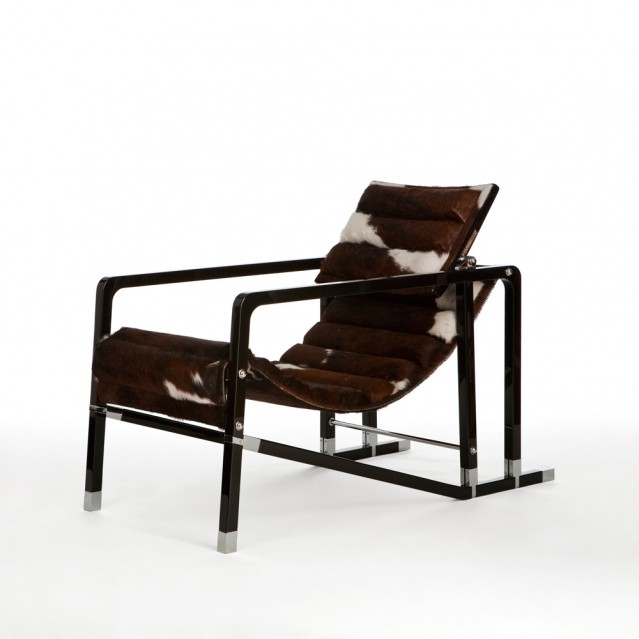
Transat
Structure in beechwood, natural- or black-lacquered, with an adjustable headrest. Chromed joints. Upholstered in leather, haired hide or linen. Designed for use on the terrace of Eileen's house E1027 at Roquebrune Cap Martin, the 'fauteuil transatlantique' takes as its starting point transatlantic steamship travel and the deckchairs used on such ships.
W 550mm D 1060mm H 790mm max
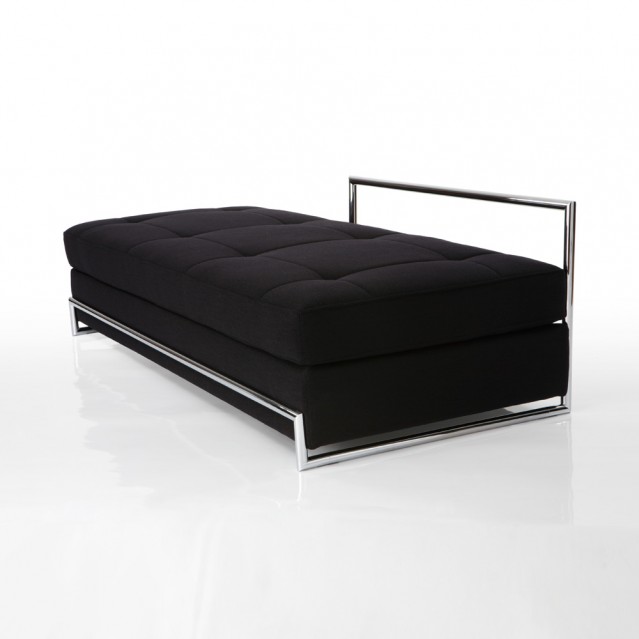
DayBed (1925)
(1925) Polished chromium plated tubular steel frame. Fully upholstered rubber sprung base with upholstered loose mattress covered in wool moquette, fabric or leather in various colours. Back frame H 600mm SH 430mm L 1950mm D 860mm *This was another special design for her new house E1027 She wanted a functional piece on which guests could sit facing any direction, and also on which they could occasionally lie down.

Lota (1924)
(1924) *Eileen Gray explained this was a development of the sofa she designed for the apartment in Rue de Lota. She achieved her desire for dual usage by allowing the removal of the loose cushions and one of the end boxes (therefore these are on castors) so the sofa serves as a bed. Her love of lacquer is expressed by its use on the end boxes - black lacquer on the front and back and a contrasting colour on the sides and top. Fully upholstered sprung base on solid wood turned feet, four loose cushions and mattress filled with feather and down with latex foam stabilizer - covered in fabric or leather in various colours. Two box units on castors detachable from sofa ends, finished in high gloss lacquer - front and back always black, top sides in four colours.
H 860mm (approx) SH 430mm O/all L 2420mm D 950mm (approx) Box O/all dims. H 550mm W 300mm L 880mm

Monte Carlo (1929)
(1929)Curved sofa with offset seat and backrest. Polished chromium plated tubular steel legs and frame. Fully upholstered seat and backrest covered in fabric or leather in various colours.
H 630mm SH 400mm O/all L 2800mm O/all D 1000mm seat D 530mm backrest D 300mm
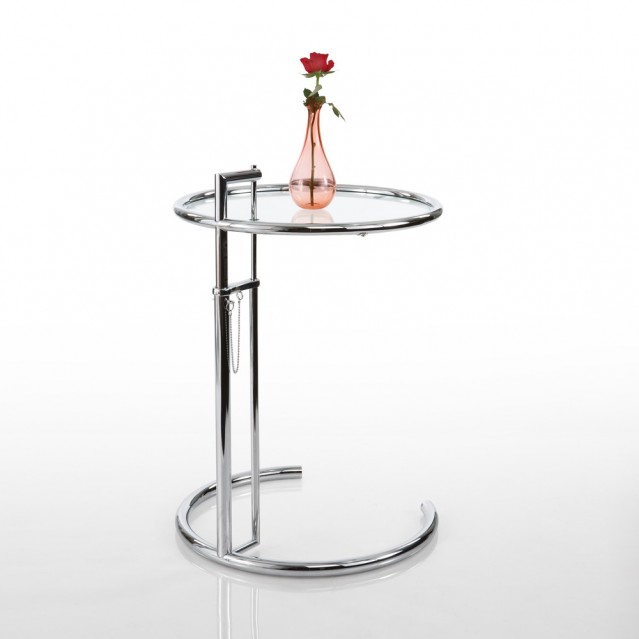
E1027 (1927)
(1927)Eileen Gray was always interested in multi-functional furniture. In this case she wanted a table for her new house in Roquebrune Cap Martin that could be used 'over her knees' while sitting, or as an occasional side or bedside table. Adjustable table. Polished chromium plated tubular steel frame. Top: Clear or tinted polished plate glass or metal satin black finish. Top can be raised to various heights.
560mm - 920mm. Top dia. 510mm For O/all heights add for 'handle' 85mm
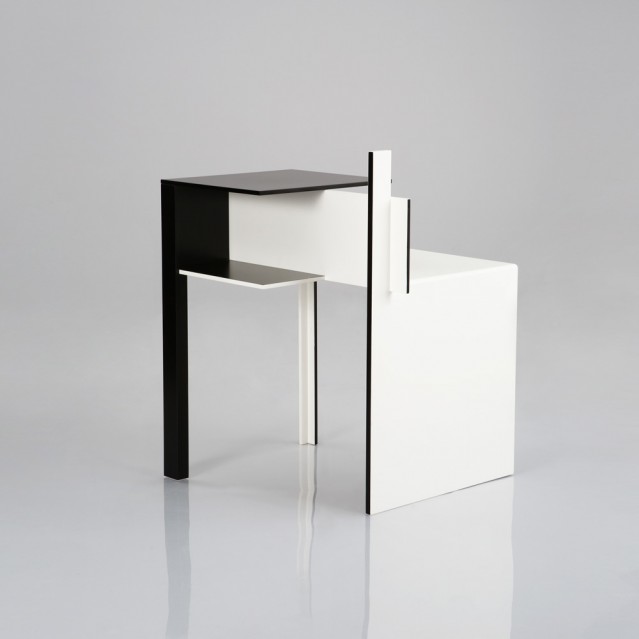
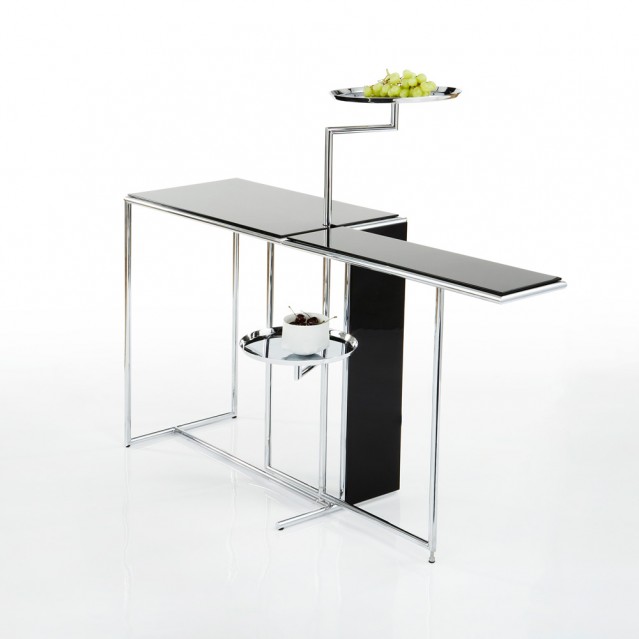
De Stijl (1922)
(1922) Multi level side table - all MDF and wood construction - satin lacquered black and white. *Eileen Gray was invited to The Netherlands by the De Stijl group - there was a mutual admiration and rapport between them. On her return to Paris she designed this table and admitted that it was 'more as an inspiration rather than as an homage'.
H 815mm Tops H 520mm & 725mm W 240mm D 615mm
Pailla (1927)
(1927) Wall or ceiling light fitting. Fixing plate with threaded and stepped cylinder - all polished chromium plated steel. Fixing plate dia.84mm O/all D (ex bulb) 120mm

Tube Light (1927)
(1927) Spun steel base and tubular steel standard all polished chromium plated, opal tube bulb with two black plastic sockets. H 1040mm Base dia. 250mm * In the 1920s the architectural tungsten strip light became very popular - 'so I decided to design a floor lamp using just a lit tube'.

Roattino (1931)
(1931)Bent tubular steel pivoting stem fixed to metal base, both finished in black satin lacquer. Parchment coloured asymmetric conical lampshade.
H 1040mm Max. depth 670mm

Brick Screen
Stainless steel rod framework. Polished solid bronze shims, spacers and end caps, coated with clear varnish. Panels with high-gloss handcrafted lacquer finish. Limited edition of 75. Eileen Gray was fascinated by the beauty of traditional lacquer-ware. She learned the centuries-old craft from a Japanese artisan and then perfected her skills over the course of many years. The Brick Screen is one of her best-known creations. She experimented with various dimensions and panel finishes. More than just a room divider, this folding screen with its understated elegance commands the presence of a sculpture. The fixed and moveable panels are lacquered by hand - layer upon layer - in a process that takes several weeks, each layer first allowed to dry completely, then sanded by hand and finally polished to an immaculate sheen. This famous piece, coveted by collectors, is part of the permanent design collection of the Museum of Modern Art in New York. Each screen is signed and given a serial number as proof of authenticity and provenance.

Folding Screen (1930)
(1930) Four curved panel folding screen. Solid beech frames with two different pattern perforated steel panels - all finished with high gloss lacquer: black, white or Chinese red. H 1680mm panel W 350mm O/all W 1425mm (when fully flat) O/all D 100mm (when fully folded) *After having designed and painted many screens in a variety of materials, Eileen Gray said she wanted to create a screen with a more 'industrial feel' by using 'ready-made' perforated steel sheets, which at the time were quite new. Being Eileen she decided 'not to conform' by using two different perforations and slightly curving each panel in its wooden frame.